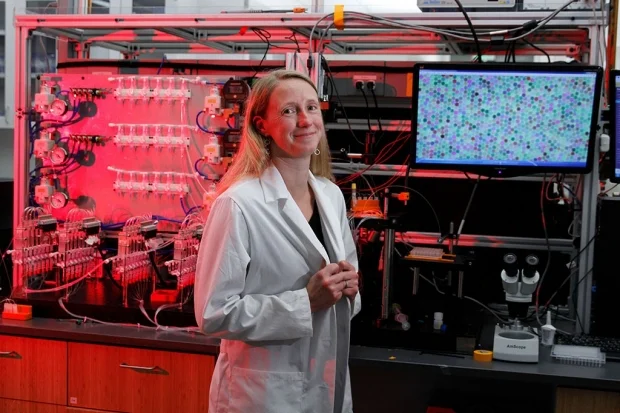
Stanford Alumni Magazine published a piece on Polly's BioE 301D course where students create microfluidic devices with real-world applications.
Read the full story here.
Stanford Alumni Magazine published a piece on Polly's BioE 301D course where students create microfluidic devices with real-world applications.
Read the full story here.
Stanford Medicine News Center published a profile on Polly and the lab's research!
Read "The beadnik: Polly Fordyce uses something tiny to do something big" here.
Welcome to Alli Keys, who has joined the Fordyce Lab as a ChEM-H Undergraduate Scholar!
Alli Keys is a sophomore from Houston, Texas, majoring in Chemistry. She previously worked as a Research Assistant at MD Anderson Cancer Center. Her hobbies include singing with the University Singers Choir, teaching Introductory Chemistry, and participating in the Stanford Axe Committee.
Polly has been awarded a 2017 Sloan Fellowship from the Alfred P. Sloan Foundation! You can read more about the Fellowship and the other awardees from Stanford here.
We are very happy to announce that Alex Sockell has decided to join the lab! Alex is a graduate student in Genetics and deep sequencing guru who previously worked as a researcher and lab manager in the Bustamante lab for 3 years. Welcome, Alex!
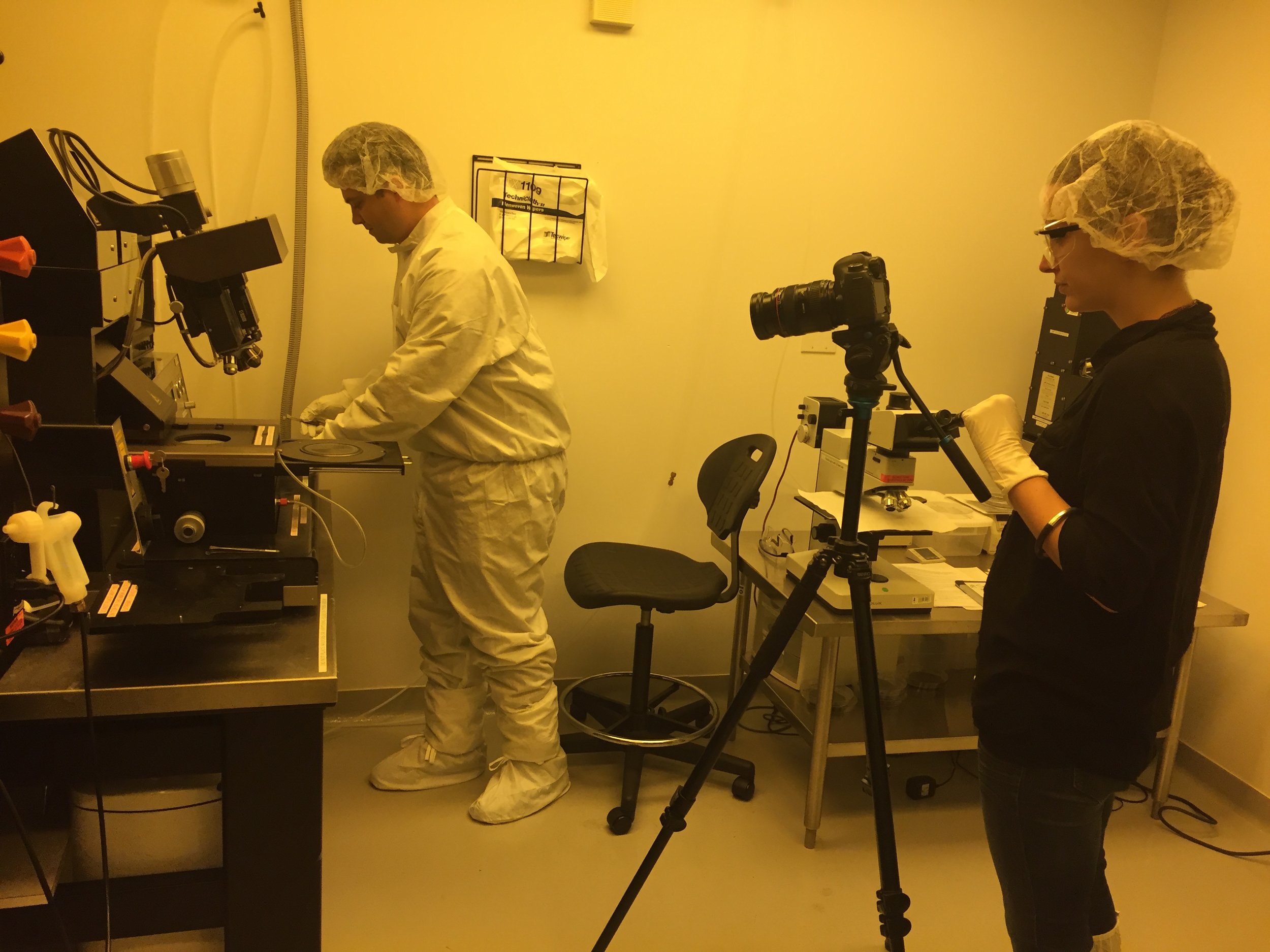
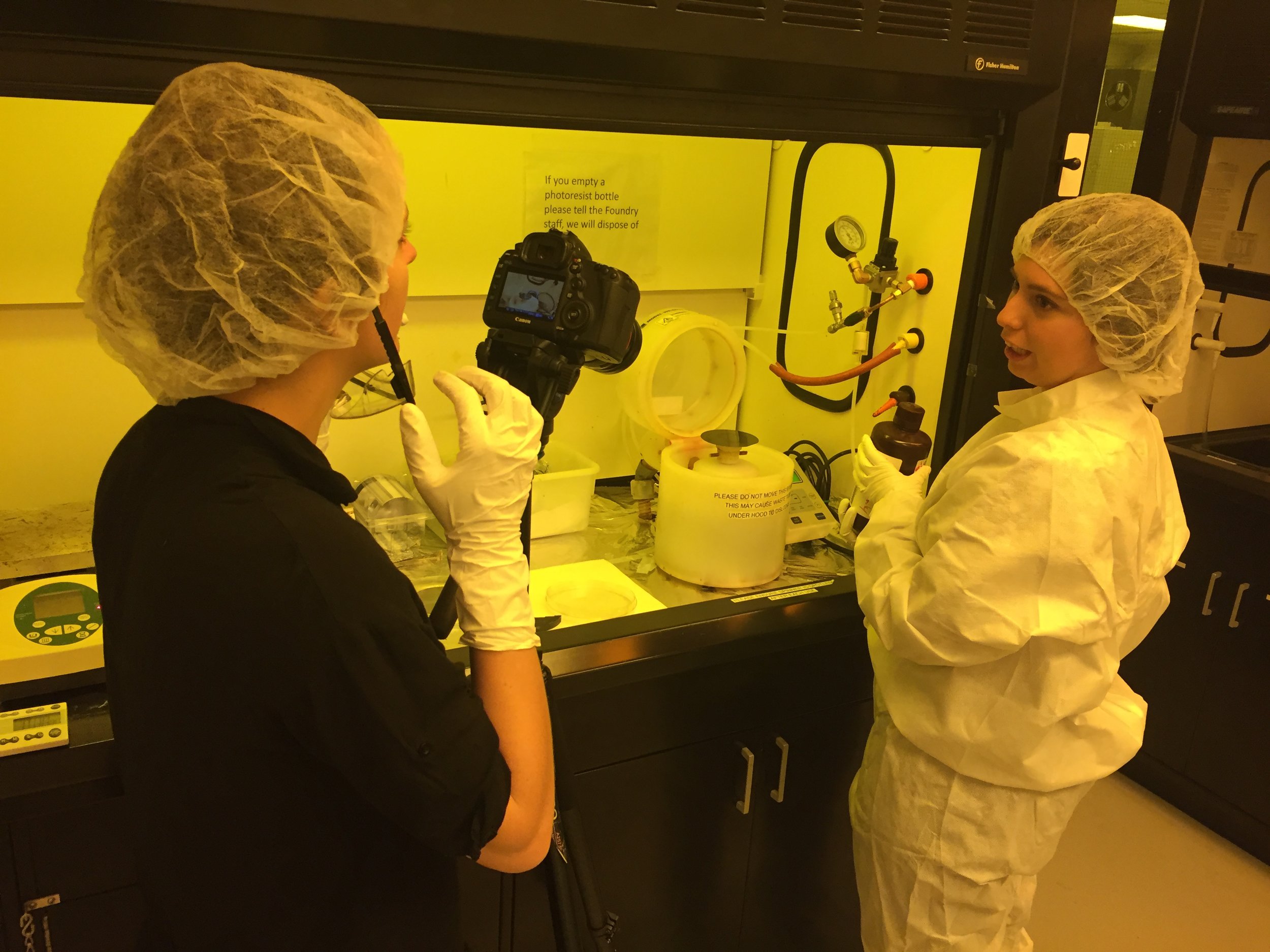
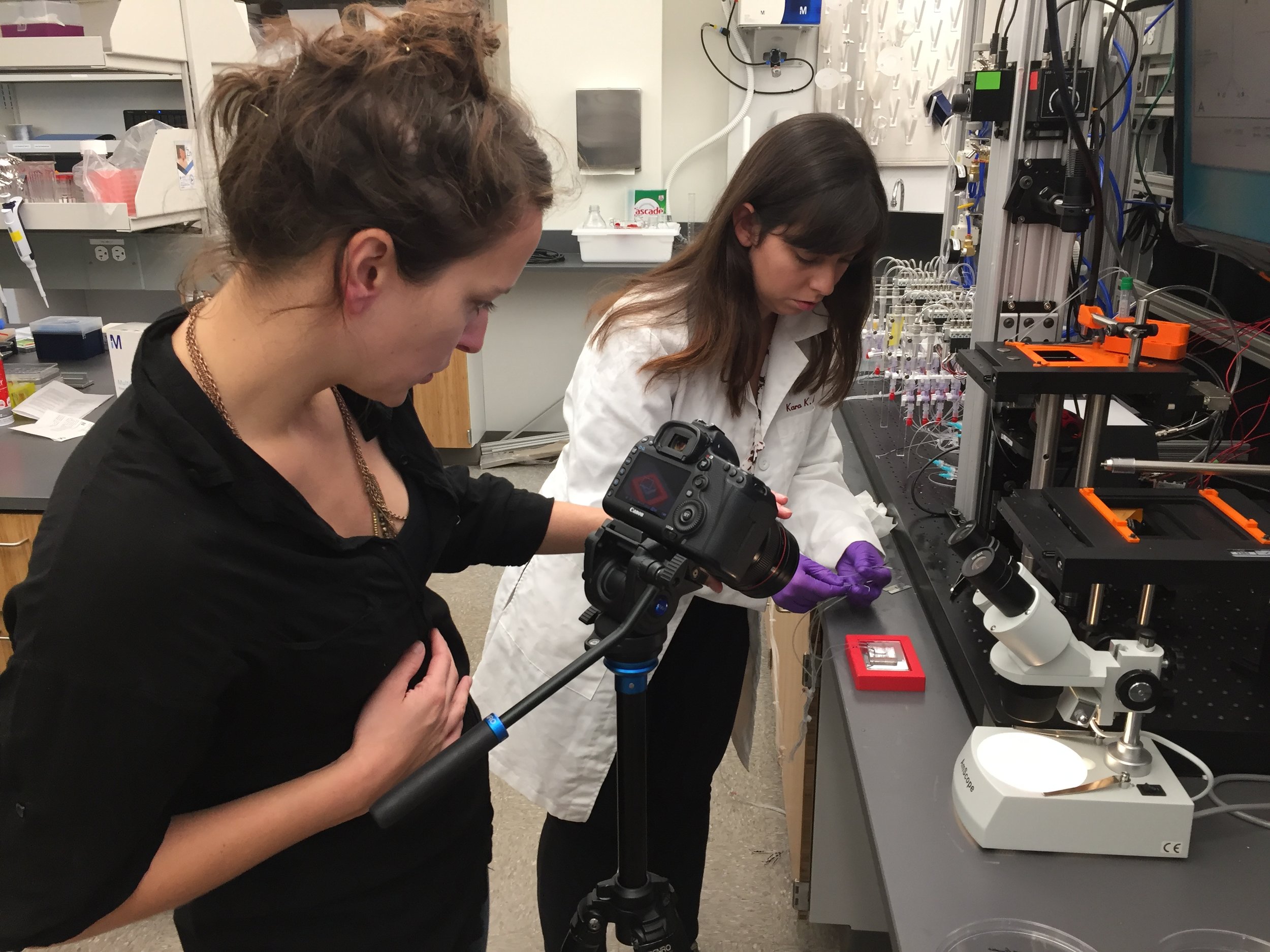
Lights, camera, complex photolithography fabrication. A film crew from JoVE came to the lab and clean room to capture Kara and Adam in action making multilayer molding masters and valved microfluidic devices for producing droplet emulsions. Some outtakes below:
Tyler passed his quals with flying colors and is now officially a PhD candidate in Genetics. Congratulations, Tyler!!!!
Our new paper describing MRBLEs (Microspheres with Ratiometric Barcode Lanthanide Encoding) containing > 1,000 different uniquely identifiable spectral codes is now out in Advanced Optical Materials. Check it out here. Congratulations to Huy and Kara for their fantastic work!
The Fordyce Lab has been awarded seed funding from Bio-X to support two projects in the lab!
The first grant, "High-throughput Quantitative Enzymology: Developing and Deploying a Novel Microfluidic Platform", funds a collaborative project with Dan Herschlag's lab in the Department of Biochemistry that is being driven by Craig Markin, a joint postdoc between our labs. The goal of this project is to develop a new microfluidic technology for producing and measuring Michaelis-Menten kinetics for thousands of rationally chosen enzyme mutants in parallel. By making these measurements, we hope to learn more about how enzymes position active site residues for catalysis and improve efforts to design new enzymes.
The second grant, "Deciphering the Language of Cellular Protein Interaction Networks Using Spectrally Encoded Peptide-Bead Libraries", funds a collaborative project with Martha Cyert's lab in the Department of Biology that is being led by Huy Nguyen. For this project, we are developing a new bead-based technology for studying how calcineurin, a human phosphatase that is the target of several immunosuppressant drugs, finds and binds its protein substrates in the cell. With these measurements, we hope to improve prediction of calcineurin substrates and deepen our knowledge of cell signaling networks in vivo.
For more information on these projects (and to see the awesome science of the other funded grants!), check out the Bio-X website.
Postdoctoral scholar Huy Quoc Nguyen has joined the Fordyce Lab! Huy graduated with a PhD in Chemistry from UC Davis and a BS from University of Washington.
Huy was just awarded a ChEM-H seed grant with Christian Lentz from Matt Bogyo's lab to develop a new assay for protease specificity on spectrally encoded beads. Congratulations!
We have three new students in the Fordyce Lab for the summer! Rebecca Bromley-Dulfano is an undergraduate from the Physics department. Alex Sockell is a rotation student with the Genetics Department. Varun Venkatesh is a high school student joining us as an intern.
Welcome!
Craig Markin was awarded a Canadian Institutes of Health Research Postdoctoral Fellowship, which carries up to five years of full support! Read more about the fellowship here.
Craig works jointly between our laboratory and the Herschlag laboratory to develop new microfluidic techniques for quantitatively measuring enzyme activity and catalysis across thousands of mutants in a single assay.
Congratulations, Craig!
Adam was recently awarded a Stanford Dean's Postdoctoral Fellowship to fund his proposal detailing developing novel assays based on using spectrally encoded beads for biological multiplexing. Congratulations, Adam!!
Arjun and Scott have decided to join the lab as permanent members, and we are psyched!
Arjun graduated with a BS in Bioengineering from UC Berkeley, where he previously worked in Carolyn Bertozzi's lab using chemistry to explore microbiology. He's now a graduate student in Bioengineering here at Stanford.
Scott graduated with a BA in Biochemistry and a minor in Computer Science from Bowdoin College, where he used bioorthogonal chemistry and mass spectrometry to study bacterial protein glycosylation. After that, he worked at the Broad Institute in an analytical chemistry lab that supported drug discovery efforts. Scott is also a graduate student in Bioengineering here.
We were recently awarded a NIST-JIMB Seed Grant with Dan Herschlag's lab to develop new microfluidic tools for high-throughput enzymology!
Tyler Shimko has recently joined the Fordyce Lab as a permanent member! Tyler graduated with a BS in Biology from University of Utah in 2015 and is now a graduate student with the Department of Genetics.
Welcome, Tyler!
Craig Markin gave a talk at the BioE retreat, and Adam, Kara, and Dan presented posters. Adam and Kara's poster was awarded first prize - congratulations, Adam and Kara!
Adam and Kara's proposal to collaborate with Melanie Gephardt to develop new technologies for investigating glioblastoma was awarded a 2 year grant from the Beckman Foundation. Congratulations!